

Beyond Illumination: Advancing Healthcare Design Through Circadian-Effective Lighting
In the evolving landscape of healthcare design, research is reshaping how architects and designers must think about lighting, moving beyond purely visual criteria toward a deeper understanding of light’s biological impact.
Circadian-effective lighting, also known as integrative lighting, is designed to support both the visual and the physiological effects of light. A growing body of research shows that people process and respond to light through two distinct pathways: our visual system, which enables sight, and our non-visual system, which regulates sleep-wake cycles, hormone production, body temperature, and a variety of other biological processes over a 24-hour period.
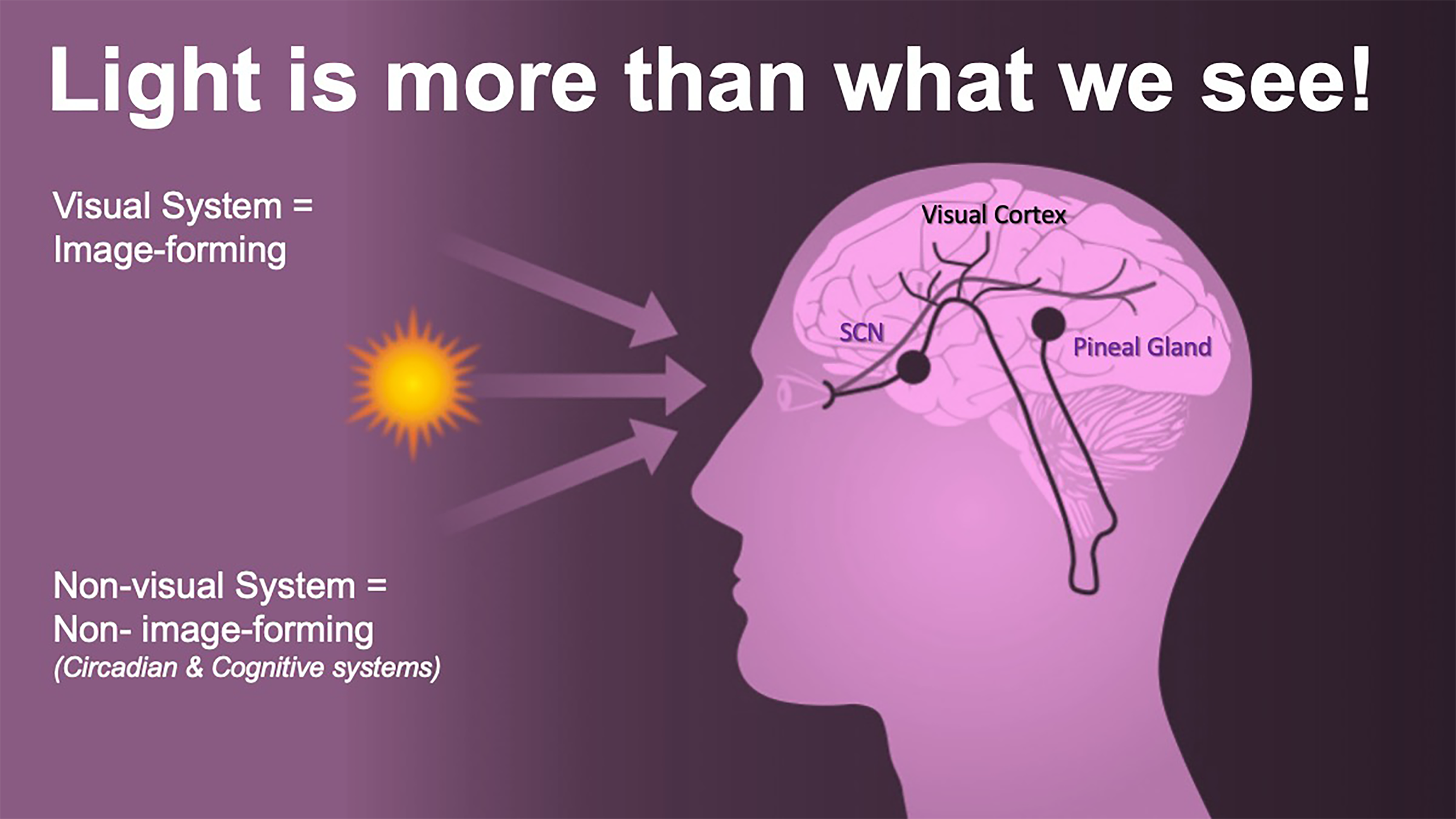
The implications for healthcare environments are profound. Research shows that lighting designed to support circadian entrainment can improve sleep quality, promote positive mood, reduce agitation, and contribute to faster recovery times for patients.
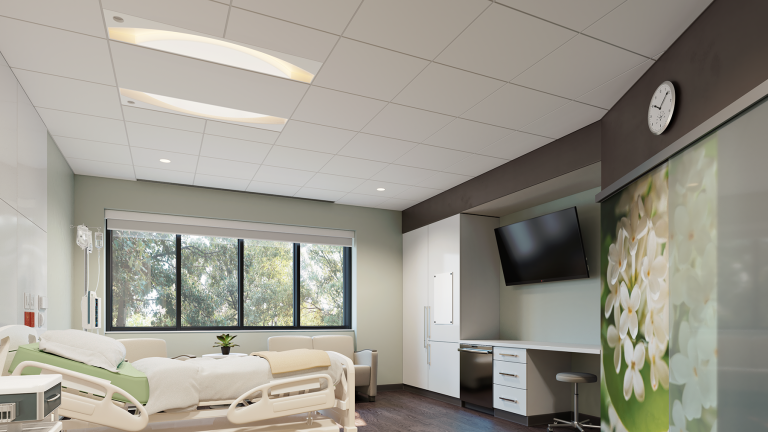
From Research to Real-World Application
Four critical factors must be considered when designing circadian-effective lighting.
- Timing
- Intensity x Duration
- Spectrum
- Spatial delivery
Circadian effective lighting design relies on performance targets measured using Melanopic Equivalent Daylight Illuminance (Melanopic EDI or m-EDI) or Circadian Stimulus (CS) which are dependent on both illumination (lux/fc) and the light’s spectrum composition. Where the light is measured is also important, with m-EDI and CS typically measured vertically at the eye.
Ambient Scenes Provide Integrative Lighting for Wellness
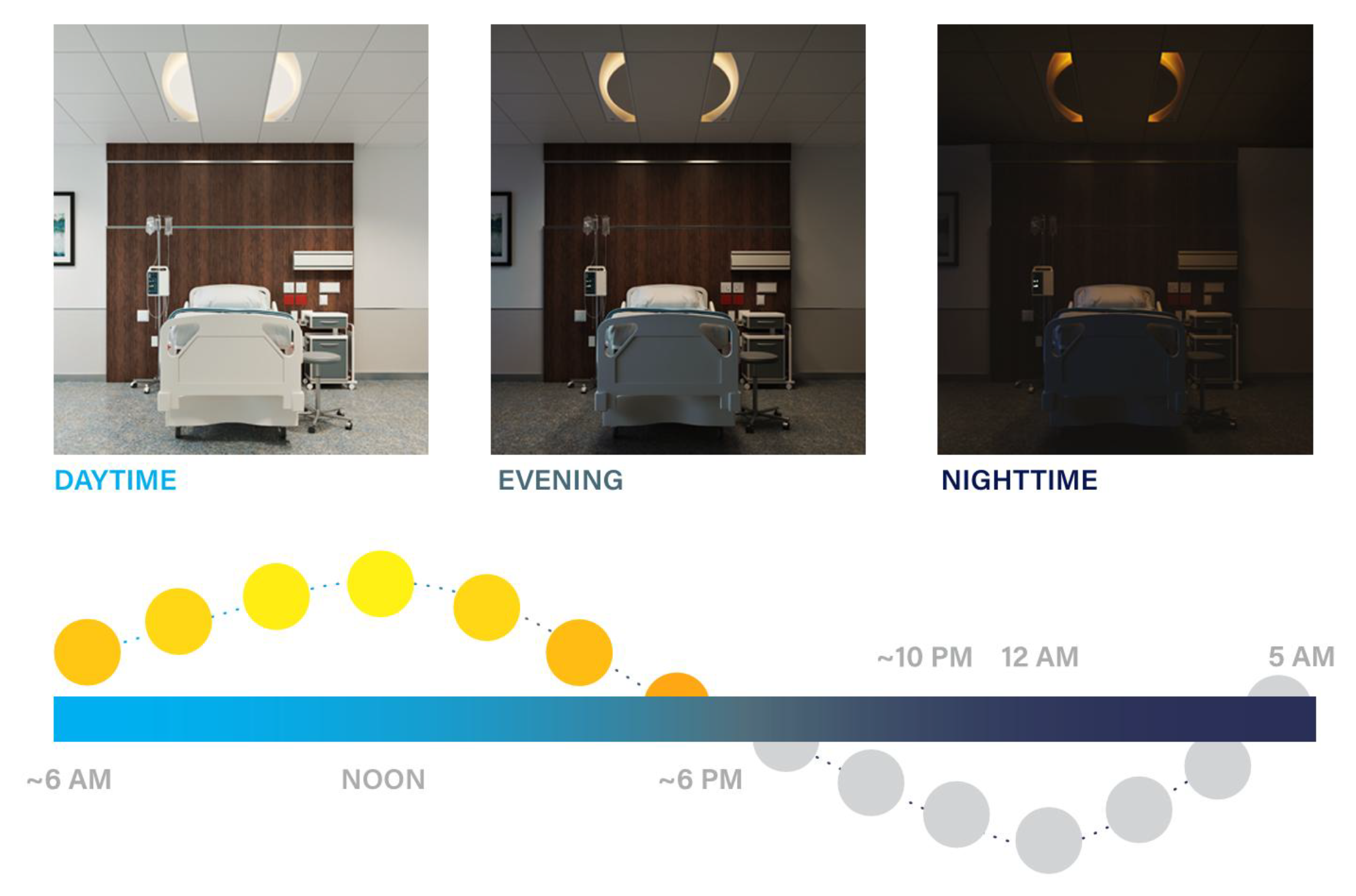
Design guides recommend higher light exposure for an extended duration (m-EDI x hrs.) during morning hours and significantly reduced light exposure in the evening and at night minimizing m-EDI, similar to light patterns found in the natural environment.
Lighting control systems can be programmed to adjust intensity and, in some cases, color throughout the day. The result is an environment that actively supports both human performance and wellbeing across a 24-hour cycle.
A Critical Application in Behavioral Health
Behavioral health environments further underscore the importance of this approach. Here, the regulation of circadian rhythms is closely tied to emotional stability, hormonal balance, and overall wellbeing.
As a result, designers are increasingly pairing circadian-effective lighting alongside biophilic elements and softer, more residential aesthetics to help reduce stress, improve mood, and support de-escalation.
Evolving Industry Guidelines
These strategies align with broader industry guidance. Organizations such as the Facility Guideline Institute (FGI), and the WELL Building Standard have guidelines that explicitly recognize circadian lighting as a key contributor to occupant health, providing measurable targets and reinforcing its role in evidence-based design. The Illuminating Engineering Society’s (IES) Recommended Practice RP-46 presents the current breadth of research and describes the variables surrounding the behavioral effects of lighting. The most specific guidance can be found in the Underwriters Laboratory (UL) Design Guide 24480, Design Guideline for Promoting Circadian Entrainment with Light for Day-Active People.
Continue the Conversation
As healthcare and behavioral health environments continue to evolve, circadian-effective lighting will play an increasingly central role in design strategies that prioritize people. It offers a way to design not just for care delivery, but as part of the care experience itself—supporting sleep, mood, cognition, and recovery.
For specifiers seeking to apply these principles, the NeoCon Virtual CEU titled: Circadian-Effective Lighting: Hospitals to Behavioral Health explores practical strategies, performance metrics, and real-world applications.
Co-presented by Star Davis, VP Innovation & Product Development at Focal Point and Patricia Rizzo, Senior Healthcare Product Manager at Kenall Lighting, this session dives deeper into the science, design strategies, and innovations shaping the future of healthcare lighting—where light can do more than illuminate; it can help heal, restore, and transform the human experience.